


Around 40-80% of people complain of low back pain, but no more than 25% of them seek medical help.In fact, these unpleasant sensations can be caused by both relatively harmless causes and pathological changes in the spine.Therefore, you should not treat them with disdain.

Causes of low back pain
The spine consists of a whole complex of structural elements: bones, joints, intervertebral discs, ligaments, nerves.Changes in any of them can be accompanied by pain of a different nature.Furthermore, the spine is surrounded by paraspinal muscles, pain that patients often confuse with back pain.So, there can be many reasons for the pain.This may be overwork, natural restructuring of the body during pregnancy, etc.But if the pain occurs regularly, it is worth contacting a vertebrologist or neurologist, as often the fact that the spine in the lower back systematically hurts indicates the development of certain diseases.

Most often in such situations, patients are diagnosed with:
- intervertebral disc pathologies (reduction in disc height, protrusion, intervertebral hernia, discitis);
- joint pathologies (spondyloarthrosis, joint cysts);
- inflammatory diseases (ankylosing spondylitis or ankylosing spondylitis, reactive arthritis, psoriatic arthritis)
- vertebral compression fractures due to osteoporosis;
- neoplastic lesions of the spine.
Intervertebral disc pathologies
Degenerative changes in intervertebral discs or osteochondrosis are very common, especially among young and middle-aged people.This is largely due to the need to sit for a long time or perform heavy physical work.In old age, the disc dries out and the vertebrae fuse.
Already in the initial stages of the occurrence of degenerative changes in the intervertebral discs, which are cartilages with a special configuration that separate the vertebral bodies, pain in the spine may occur.This is due to irritation of the pain receptors of the outer layers of the disc, as well as the posterior longitudinal ligament of the spine.Often, osteochondrosis provokes an aseptic inflammatory process, which leads to a reflex spasm of segmental muscles.As a result, back pain intensifies and mobility restrictions occur.
Osteochondrosis tends to progress constantly, especially in the absence of adequate treatment and lifestyle correction.Subsequently, it leads to the formation of protrusions and, subsequently, intervertebral hernias, which causes the existing symptoms to worsen and new ones to appear.
The lumbar region, as it bears the greatest loads in daily activities, is the most affected.

The protrusions are protrusions of the disc, maintaining the integrity of its outer layer, called the fibrous ring.If the influence of provoking factors persists over time, the fibers of the fibrous ring cannot withstand the load and pressure of the internal contents of the disc (nucleus pulposus) and rupture.As a result, the nucleus extends beyond the physiological position of the intervertebral disc.In this case, the spine always hurts in the lower back or the pain radiates to the leg, and the discomfort intensifies with sudden movements, bending over, lifting heavy objects, straining, coughing, sneezing, laughing, as well as sitting in the same position for a long time, walking, standing.
Often, patients with already formed protrusions and hernias unconsciously take a forced position, slightly tilting in the healthy direction.At the same time, pain in the lumbar spine can reach high intensity, depriving the person of the ability to work.In such cases, he is forced to adhere to bed rest and, to alleviate the pain, squeeze the bent leg brought to the stomach.
Most often, protrusions and hernias form toward the spinal canal, which contains the spinal cord (cauda equina) and the nerve roots that branch from it.The latter pass through natural openings in the vertebral bodies and branch into the lumbar plexus, which is responsible for the innervation of the lower extremities and various organs (including the genitals).

Therefore, often with long-term osteochondrosis, the formation of hernias in the lower back, pain in the spine gradually not only intensifies, but is also complemented by other disorders.If a deformed disc or soft tissues swollen due to an inflammatory process compress the spinal root passing near them, neurological disorders occur.Therefore, back pain in the lower back can be complemented by pain radiating to the buttocks, groin, front, inner, outer thigh, lower leg and foot.This depends on which nerve root will be pinched, that is, in which segment of spinal movement pathological changes will be observed.In addition, in the corresponding areas of the lower extremities, sensitivity disorders can be observed in the form of a crawling sensation, numbness, changes in temperature susceptibility, pain, tactile stimuli and limited mobility.
The changes in the height and functionality of the discs that occur in osteochondrosis and its complications lead to damage to the articular apparatus of the spine, as well as degeneration of the vertebral bodies themselves.The consequence of this is the development of spondylosis, that is, calcification of the anterior longitudinal ligament and the formation of osteochondral growths on the surface of the vertebral bodies (osteophytes).They can not only injure the surrounding tissues and compress the spinal roots, causing severe spinal pain, but also fuse with each other.As a result, adjacent vertebral bodies are combined into a single whole, which sharply limits mobility in the lumbar region.
Osteochondrosis can be accompanied by reactive changes in the vertebral bodies, in particular reactive aseptic spondylitis, leading to osteosclerosis.This is accompanied by compaction of bone tissue and drastically increases the likelihood of vertebral fractures.
Facet joint diseases
Pathologies of the facets or joints of the lumbar region, in particular osteoarthritis, can also cause spinal pain in the lumbar region, including severe pain.Although more often the pain is aching and localized deep inside.Its appearance is due to the fact that its synovial capsule is richly innervated.In these situations, the pain is usually concentrated directly in the affected area and tends to intensify when bending, straightening, turning the body or standing for long periods of time.Walking and sitting help reduce its severity.But in some cases, the pain can also radiate to the groin area, coccyx, as well as the back and outer thighs.

Inflammatory diseases of the spine
Inflammatory diseases of the spine are less common than pathologies of the intervertebral discs and facet joints.However, they also cause back pain.These include:
- Ankylosing spondylitis or ankylosing spondylitis;
- reactive arthritis;
- psoriatic arthritis, etc.

Signs of these diseases usually appear before the age of 40 and more often in the 20s.This distinguishes them from degenerative-dystrophic pathologies of the discs and joints of the spine, which develop more frequently after the age of 40.In this case, the pain is characterized by a gradual increase in intensity.At the same time, its severity decreases after physical activity, but does not decrease at rest.Therefore, with inflammatory diseases, the spine in the lower back often hurts at night and especially in the morning, immediately after sleep.
The most serious situation is seen in ankylosing spondylitis and it is this disease that affects the lower back more frequently than other inflammatory diseases.This term refers to inflammation of the intervertebral joints followed by their immobilization due to the formation of dense bony, cartilaginous or fibrous fusion between the articulating bony structures.
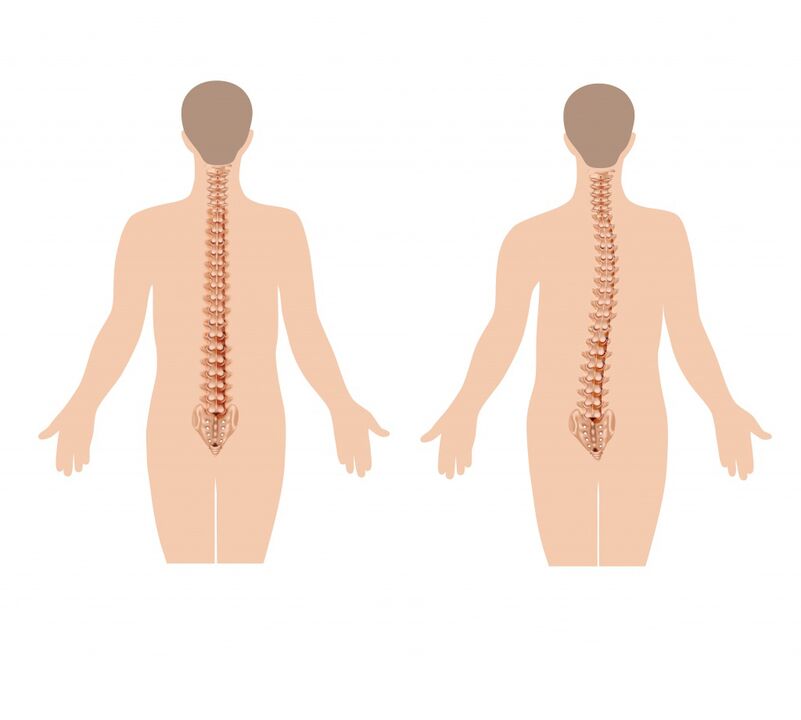
At first it is characterized by mild pain in the lower back, but over time they gradually spread upward, covering the thoracic and then the cervical spine.This is associated with the development of limited mobility of the spine in all planes, since the spine, as a result of the changes occurring, seems to be immersed in a specific case.Also noted:
- alignment of the lumbar lordosis (natural curve of the spine in the lumbar region);
- worsening of thoracic kyphosis, which causes curvature;
- reflex tension of the back muscles;
- progressive worsening of limited mobility due to the involvement of the facet joints and ossification of the intervertebral discs in the pathological process;
- morning stiffness for an hour or more.
In 10-50% of patients, inflammation of the iris (iritis), cornea (keratitis), mucous membrane (conjunctivitis), iris and ciliary body of the eyeball (iridocyclitis) is observed.
The progression of ankylosing spondylitis leads to the fact that an increasing number of joints become pathological.As a result, patients are forced to acquire the so-called supplicant posture.It means pronounced kyphosis of the thoracic spine, tilting of the upper body downwards, flexion of the legs at the knees with a marked limitation of the range of movement of the chest, which affects the depth of breathing.
The rate of disease progression depends on the adequacy and completeness of treatment.
Vertebral compression fracture
A compression fracture is a flattening of the vertebral body, causing it to become wedge-shaped.This leads to disruption of the anatomy of the spine, can provoke injury to the spinal cord and its roots, and also become a trigger for the rapid progression of degenerative changes.
The 1st and 2nd lumbar vertebrae are most susceptible to injuries as they bear the greatest axial load.

Often, compression fractures of the spine occur in elderly people due to the development of osteoporosis, that is, a decrease in bone density.In these cases, not only a small fall, but also an unsuccessful heavy lifting or movement can be enough to cause injury.
The pathology is characterized by the presence of pain in the spine, which limits movement and intensifies when sitting, moving and trying to lift a straight leg.It usually lasts 1 to 2 weeks and then gradually subsides over 2 to 3 months.In some cases, the pain radiates to the iliac crests and thighs.Decreasing the height of a broken vertebra causes an increase in lumbar lordosis, which also contributes to the occurrence of pain.
If the fracture is not diagnosed in a timely manner, the decrease in vertebral height leads to changes in posture and a decrease in height.This causes reflex tension and shortening of the spinal muscles, which causes chronic back pain and requires long periods of rest.
Neoplastic lesions of the spine
Neoplastic lesions of the spine mean the formation of benign and malignant tumors in it, as well as metastases, the origin of which are neoplasms of other organs.This occurs much less frequently than pathologies of intervertebral discs, facet joints, ankylosing spondylitis and even compression fractures, namely in only 1-2% of patients with back pain.But these injuries require diagnosis and treatment as early as possible.

The characteristic features of neoplastic lesions of the spine, in addition to pain, are:
- increased body temperature, including subfebrile levels;
- causeless weight loss;
- inability to find a comfortable body position;
- the presence of pain at night;
- severe pain in the spine;
- inability to relieve pain with conventional analgesics.
Even if you have 1 or 2 of these symptoms, you should make an appointment with your doctor immediately.
The following may appear in a similar way:
- Chondroma is a malignant tumor diagnosed in 20% of patients with cancerous lesions of the spine.Most often, it forms in the sacrum and can occur in people of any age and gender.
- Young's sarcoma - occurs in 8% of patients with neoplastic lesions of the spine.More typical for young men.
- Chondrosarcoma is a malignant neoplasm, responsible for 7 to 12% of cases.Most often found in middle-aged men.
- The aneurysmal bone cyst is a benign neoplasm.
- Hemangioma is a benign vascular tumor present in 11% of people.It may not be detected throughout a person's life.But it increases the risk of vertebral fractures.
- Metastases from other tumors are secondary malignant neoplasms.Most often, breast, prostate, and lung cancers metastasize to the spine, and less frequently, kidney, thyroid, and skin cancers.
Diagnosis
If your back hurts in the lower back, make an appointment with a neurologist or vertebrologist.During the consultation, the doctor initially takes an anamnesis, clarifying doubts about the nature of the pain, the circumstances of its occurrence, the duration of its persistence, the presence of other symptoms, lifestyle, etc.
Then the specialist performs an examination.As part of it, he not only palpates the spine, determines the location of the pain, assesses the gait and posture that the patient unconsciously assumes, but also performs functional tests.With their help, you can detect signs of ankylosing spondylitis, neurological deficits, assess the degree of spinal mobility and obtain other diagnostic data.
Based on this, the doctor can now suggest possible causes of the pain.To clarify them, as well as to accurately determine the extent of damage, instrumental and sometimes laboratory diagnostic methods are additionally prescribed.Most often they resort to help:
- Radiographs in frontal and lateral projections, sometimes with functional radiographic examinations;
- Computed tomography – allows better visualization of bone structures, which is why it is most used to diagnose spondylosis, fractures, bone tumors, etc.;
- magnetic resonance imaging – allows you to assess the state of cartilaginous structures and soft tissues in more detail, therefore it is most often used to diagnose osteochondrosis, protrusions, intervertebral hernias, spinal injuries, etc.;
- electromyography - indicated for neurological disorders of unknown origin, as well as to assess the degree of nerve damage;
- radioisotope osteoscintigraphy – used to diagnose malignant tumors and metastases;
- X-ray densitometry is the ideal method for diagnosing osteoporosis;
- myelography – used to identify signs of compression of the spinal cord and nerves of the cauda equina.

Treatment
For each patient, treatment is selected strictly individually, not only based on the diagnosis, but also on the nature of the existing concomitant pathologies.However, the cause of lower back pain, of course, determines the treatment tactics.It may be conservative or involve surgical intervention.
But the first step is always to alleviate the pain, especially if it is intense.For this, patients are prescribed NSAIDs, antispasmodics and analgesics.And in severe cases, spinal anesthesia is performed - injections of anesthetics and corticosteroids at certain points in the spinal region.
Bed rest is not recommended for all patients.And in the case of pathologies of the intervertebral discs, it can be completely contraindicated, as a decrease in physical activity contributes to the transformation of acute pain in the spine into chronic pain.
Exclusively conservative or non-surgical treatment is prescribed for:
- osteochondrosis;
- Bekhterev's disease;
- arthrosis of the facet joints;
- mild compression fractures.
It is usually complex and consists of:
- drug therapy, which may include NSAIDs, chondroprotectors, muscle relaxants, immunosuppressants, corticosteroids,
- physiotherapy (UHF, magnetic therapy, laser therapy, traction therapy, etc.);
- exercise therapy;
- manual therapy.

If the cause of low back pain is intervertebral hernia, protrusion, spondylosis, severe vertebral fractures, tumors, surgery is often indicated.It is also necessary for:
- ineffectiveness of conservative therapy for degenerative changes;
- increased neurological deficit;
- instability of the motor segment of the spine;
- the development of complications, in particular stenosis of the spinal canal.
Most modern operations performed on the spine are minimally invasive.Thanks to this, intra- and postoperative risks are drastically reduced, the rehabilitation period is shortened and facilitated, and the effectiveness is not inferior to the most traumatic open operations.Depending on the disease detected, the following may be recommended:
- Discectomy is an operation indicated mainly for hernias and protrusions, especially those that cause cauda equina syndrome.It can be performed with microsurgical instruments through an incision of approximately 3 cm (microdiscectomy) and with endoscopic equipment taken to the spine through punctual punctures with a diameter of approximately 1 cm (endoscopic discectomy).When an intervertebral disc is completely removed, it is usually replaced with implants.
- Vertebroplasty and kyphoplasty are indicated for compression fractures of vertebrae, hemangiomas and some other diseases.The essence of the operation is to introduce fast-hardening bone cement through a thin cannula into the vertebral body, strengthening it.With kyphoplasty, it is also possible to restore the normal dimensions of the vertebral body, which is important in the case of a serious decrease in its height as a result of a fracture.
- Fixation surgeries are used to stabilize the spine.To this end, metal structures of different types are used, which generally remain in the patient's body until the end of their life.
Thus, the spine in the lower back can hurt for several reasons.Therefore, if the pain persists for a long time, if it occurs regularly, if the pain intensifies over time and even more so with the addition of other symptoms, you should definitely consult a vertebrologist or neurologist.Early diagnosis will make it possible to detect pathological changes at the stages in which they are easiest to face and, if not completely cure the disease, at least stop its progression and maintain a high standard of living.